
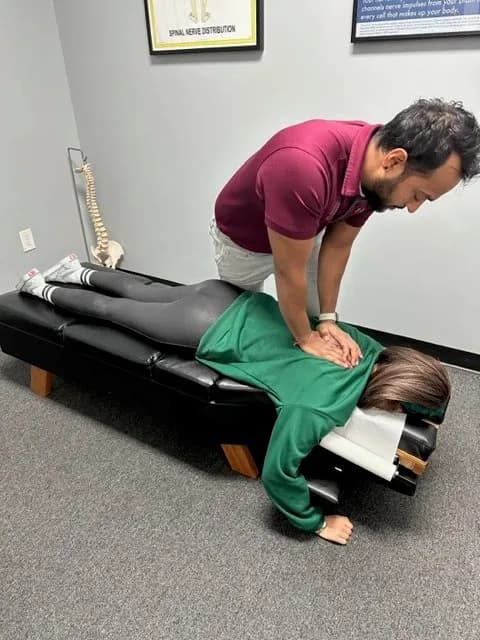
What a chiropractic adjustment actually does
A chiropractic adjustment is a controlled, targeted force applied to a joint that has lost its normal range of motion. When a spinal joint stops moving the way it should, the small nerves surrounding it, the ones that tell your brain where your body is in space, start sending distorted signals. Your brain responds the only way it knows how: it tightens the surrounding muscles, guards the area, and turns up the volume on pain.
Restoring motion to that joint interrupts the cycle. Patients usually describe immediate relief in tension and a noticeable return of freedom in the neck, mid-back, or low back. What is happening underneath is a reset of the conversation between your joints, your muscles, and your brain.
How we adjust at Breakaway
There is no single correct way to adjust a spine, and there is definitely no one technique that suits every body. Dr. Rakesh Lad and Dr. Hasheen Lad are trained in a range of approaches and will choose based on your exam findings, your comfort level, and your history.
- Diversified, the classic hands-on adjustment, precise and fast, often with an audible release
- Drop-table (Thompson), segmented table pieces drop a fraction of an inch so less force is needed
- Instrument-assisted (Activator), a small handheld tool delivers a gentle impulse with no twisting; ideal for kids, seniors, and anyone nervous about being adjusted
- Flexion-distraction, a table that gently stretches and decompresses the low back, useful for disc-related pain
- Extremity adjusting, shoulders, elbows, wrists, hips, knees, ankles, and feet, not just the spine
You will never be adjusted before you are examined
Every new patient goes through a full orthopedic, neurological, and postural exam before anyone touches your spine, and we take digital X-rays on site when your history or findings call for them. That matters: the goal is not to adjust everything, it is to find the specific joints that are not moving and leave the ones that are already hypermobile alone.
We then sit down with you and walk through what we found on your images and what we believe is driving your symptoms. You will leave that visit understanding your own spine.
Benefits of chiropractic adjustments
- Improved joint range of motion and flexibility
- Reduced muscle tension and spasm
- Decreased pain without medication
- Better posture and body awareness
- Improved athletic performance and recovery
- Fewer recurring headaches and less neck stiffness
Conditions we use this for
Back Pain
The most common reason people find us, and one of the most treatable, once you know what is actually causing it.
Neck Pain
Your head weighs about twelve pounds, and every inch it drifts forward multiplies the load your neck has to hold all day.
Sciatica
Shooting pain from the low back into the leg is a nerve problem, and treating the muscle it runs through will never solve it.
Headaches & Migraines
A large share of chronic headaches originate in the neck, which is why they keep coming back no matter what you take for them.
Pinched Nerve
When a nerve is compressed, the pain often shows up far from the actual problem, which is why chasing the symptom rarely works.
Shoulder Pain
The shoulder trades stability for range of motion, which is exactly why it goes wrong so often, and why local treatment alone rarely fixes it.
Chiropractic Adjustments: common questions
Does a chiropractic adjustment hurt?
For the vast majority of patients, no. Most people describe it as a quick pressure followed by relief. If you are in acute spasm the area can be tender, so we start gently and use low-force techniques until the muscle guarding settles down. Tell us if anything is uncomfortable. We will change the approach.
What is the popping sound?
It is called a cavitation. Gas dissolved in the fluid inside your joint capsule comes out of solution when the joint surfaces separate slightly, the same physics as opening a bottle of soda. It is not bones cracking and it is not a sign the adjustment worked. Many of our techniques, like Activator and drop-table, produce no sound at all.
Once I start, do I have to go forever?
No. We give you a defined care plan with a beginning, a middle, and an end, and we re-examine you along the way to prove you are progressing. Once you are out of pain and stable, many patients choose to come in periodically for maintenance the way they would see a dentist, but that is your call, not a requirement.
How many visits before I feel better?
Most patients notice meaningful change within the first two to four visits. How long full correction takes depends on how long the problem has been there, whether discs or arthritis are involved, and what you do outside the office. We will give you an honest estimate after your exam rather than a generic number.
Do I need a referral from my doctor?
Not in Texas. Chiropractors are portal-of-entry providers, so you can call and book directly. If your specific insurance plan requires a referral we will tell you during your benefits check before your first visit.