The part that makes results permanent
Passive care gets you out of pain. Active care keeps you out. If the muscles responsible for holding a joint in position are weak, inhibited, or simply not firing in the right sequence, that joint will drift back toward dysfunction the moment you leave the office, and you will be back in the same spot in six months.
This is the difference between a practice that manages your pain indefinitely and one that resolves it. We would rather do the second.
Intrinsic muscles, not just the big movers
Most people who have been given back exercises were handed something that trains the large superficial muscles. But spinal stability comes primarily from small deep stabilizers, multifidus, transverse abdominis, the deep neck flexors. That are typically the first to shut down after injury and the last to come back on their own.
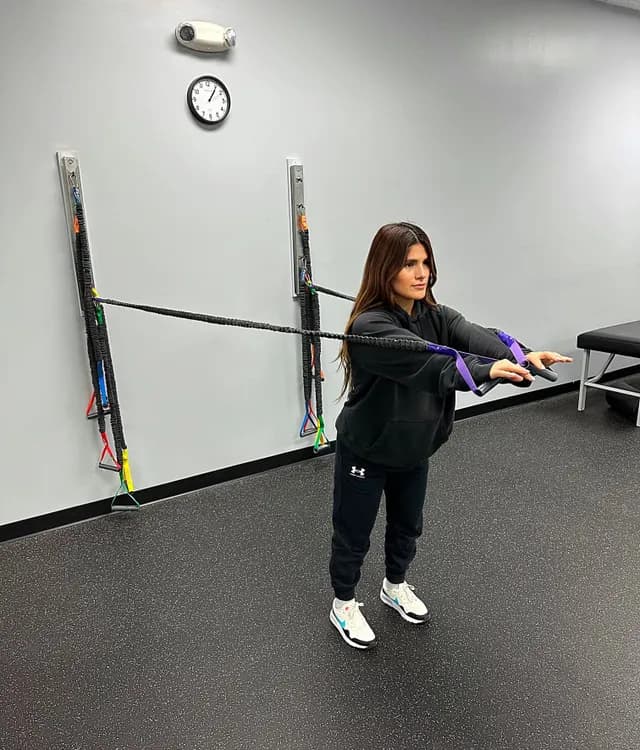
We prescribe specific exercises to strengthen those intrinsic and extrinsic muscles while modifying the neuromuscular system: retraining not only how strong a muscle is, but when your brain chooses to fire it.
Realistic, progressive, and taught properly
We start with a small number of movements you can actually perform, teach them in the office until your form is correct, and progress them as you improve. Nobody gets a printout of twenty exercises they will never do.
For athletes, we take this further and build toward the specific demands of your sport, rotational power for a hockey slap shot, single-leg stability for soccer, overhead control for volleyball.
Benefits of functional exercise & rehabilitation
- Prevents the same injury from recurring
- Strengthens deep stabilizers most programs miss
- Retrains movement patterns, not just muscle strength
- Reduces long-term reliance on passive care
- Sport-specific progression for athletes
Conditions we use this for
Back Pain
The most common reason people find us, and one of the most treatable, once you know what is actually causing it.
Neck Pain
Your head weighs about twelve pounds, and every inch it drifts forward multiplies the load your neck has to hold all day.
Shoulder Pain
The shoulder trades stability for range of motion, which is exactly why it goes wrong so often, and why local treatment alone rarely fixes it.
Knee Pain
The knee is a hinge stuck between two joints that rotate, so it usually hurts because of what the hip and foot are doing.
Hip Pain
Stiff, weak hips do not stay a hip problem for long. They hand their workload to the low back and the knees.
Text Neck & Posture Problems
Forward head posture is not a cosmetic issue. It is a mechanical load your neck carries for ten hours a day.
Functional Exercise & Rehabilitation: common questions
Do I need a gym for these exercises?
No. Nearly everything we prescribe uses body weight or a resistance band we can send home with you. The barrier to doing your rehab should be as close to zero as possible.
How much time will this take each day?
Most programs run five to ten minutes. Consistency matters far more than duration, three focused sessions a week that you actually complete beat a daily program you abandon.
What if an exercise hurts?
Stop and tell us. Mild muscular fatigue is expected; sharp pain, radiating symptoms, or numbness are not. Usually it means the form needs correcting or the progression came too early, and both are easy to fix.